Are you a slave?

I am not shying away from dicey topics. If you’re a sensitive person who doesn’t have the heart to talk about issues that plague society to this day, I’m afraid this entry is not meant for you. But if you think you have tough enough skin to handle said conversations, feel free to stay and even critique how I critique this issue. I must warn you, although I will touch on slavery as how pop culture sees it, it’s other, often unspoken of side will take on the spotlight. Here goes.

How does pop culture or mainstream media or even woke people define slavery? Oftentimes they unapologetically use the term to pertain to the slavery of black people. We can’t blame them. Mainstream media portrays their slavery most common. Encyclopedia Brittanica’s definition fits well with this:

“There is no consensus on what a slave was or on how the institution of slavery should be defined. Nevertheless, there is general agreement among historians, anthropologists, economists, sociologists, and others who study slavery that most of the following characteristics should be present in order to term a person a slave. The slave was a species of property; thus, he belonged to someone else. In some societies slaves were considered movable property, in others immovable property, like real estate. They were objects of the law, not its subjects.”

The general idea behind slavery is having little to no freedom or having someone else dictate what you can and can’t do, simply on the basis of class, of birth, and of race. If I were to ask you whether or not this is right, I am sure you’d unanimously answer no. If class, birth, and race are not factors that define what freedom we have, then what should?

Step back.

One of the most sensible answers to this is our humanity and how freedom is a consequence of it. I completely agree. Our ‘selves’ belong only to us. Who we are, what we want, what we aspire to be, these things are only determined by us simply because our ‘selves’, that is, our bodies and our minds are only ours. Let me take this opportunity to segue into the often unspoken, often unknown kind of slavery: the slavery of ourselves by ourselves, or “moral” slavery. This is imprisonment by our excessive desires such as lust, gluttony, greed, and every other vice; and anxiety over things beyond our control. Both hinder us in becoming better persons with the former trapping us in a vicious cycle of repetitive, unproductive actions, while the latter slowing or completely halting us from doing what we want out of fear of the unknown.

What does the Emperor say?

If you are familiar with Marcus Aurelius, then you have to understand why I refuse to tackle this at length. He was a Roman Emperor, plain and simple. Given the power at his disposal, he could have abolished slavery or at the very least have the people question the need for it. There are other persons who can discuss the complex structure of the Roman empire better than I, so I choose to leave it at that.

Shift the focus away from the person to the philosophy. What does stoicism say about slavery? Marcus Aurelius’ private journal-turned-stoic-literature provides insight. He shared the similar stoic view of cosmopolitanism or the mindset that likens humans to animals that work together for the common good. Think of ants, bees, wolves. He wrote:

“We were born to work together like hands, feet, and eyes, like the two rows of teeth, upper and lower. To obstruct each other is unnatrual. To feel anger at someone, to turn your back on him: these are obstructions.”

This gives us a more nuanced understanding of what the stoics or at least he, had on the rest of mankind. Aurelius narrows down and upholds this when he wrote:

“…treat them as the law that binds us – the law of nature – requires. With kindness and with justice.”

By removing the man from the equation, stoicism tells us to treat each other compassionately, as if we everyone was our kin or an indispensable part of the whole. But what of that greater slavery? The one Seneca says is more disgraceful than anything else? What do the stoics say about self-imposed slavery?

Becoming your own slave

What does it mean to be a self-imposed slave? It’s to be dragged everywhere our desires lead us to, effectively putting the body above the mind. As rational beings, it is in our nature to to think and to act in a way that is proper to humans. Stoicism teaches that this proper way of being is done by being virtuous or acting with self-control so that we never do too little nor too much of one thing. It is by being virtuous that we act in accordance to our human nature and thus, free. In simpler words, to be human (which also means to be free) is to be in equilibrium or at balance with all things.

We become slaves to ourselves when we stop being human, when we disrupt the equilibrium, when we let go of our control over our desires, when we don’t think before doing. We become slaves by abandoning our human nature and start behaving like animals or creatures significantly less free than humans (or how we’re ought to be).

How will I know if I’m a slave?

We all have our daily schedules either as students or as working adults. Take a step back and observe how your typical weekday goes. Say you’re an adult like me, what do you do the moment your alarm wakes you up? Do you hit the snooze button and squeeze in more sleep or do you resist the urge and rise up instead? When you walk or commute to the office, do you grab a cup of coffee and some breakfast? Do you scroll through social media while you work or do you focus on work alone? Write down your daily routines and judge your own habits. Take me for example. I am fond of drinking coffee. As I took a step back to observe myself I noticed that I drink it everyday, twice minimum. Now while drinking the beverage itself is not a bad thing, I discovered that there are occasions when I drank not for the sake of waking up, but for drinking for the sake of drinking. And that, I believe, is being a slave to something. Caffeine was my master and I was its slave. What I did to regain control was to limit my consumption into 2 cups per day, only exceeding when I absolutely need the boost to finish work.

You are the problem, but also the solution.

Although regaining control from established habits sounds easy on paper, it may not always be the case. I struggled to set the limit to my coffee intake, but with the help of stoicism, I overcame and broke my habit. If you, too, are struggling with bad habits, keep in mind the words of Marcus Aurelius:

“Stop allowing your mind to be a slave, to be jerked about by selfish impulses, to kick against fate and the present, and to mistrust the future.”

Take whatever you’re experiencing as something that you need to experience. If you are a student of stoicism or wonder what the philosophy has to say about it, remember that life happens for us, not to us. We decide how to play the cards we are given.

My Mo(u)rning Routine

There are few words that stir dread to us fearless youth. Responsibilities, commitments, 13 missed calls from mom are some of them. But nothing strikes quite as hard as weekday mornings when we have to get up to prepare for school or work, fighting against the pull of gravity generated by our beds. Rising is a chore itself. But this is just one of the things we have to go through each day. The list includes the assholes we encounter during commutes or in the workplace, the work itself, and the random misfortune to top it all off. What can one do when the universe itself seems to conspire against us? Taking a stoic approach enabled me to face these daily endeavours with grace and strength. Now I share it with you.

Negative Visualization

“When you wake up in the morning, tell yourself: the people I deal with today will be meddling, ungrateful, arrogant, dishonest, jealous and surly. They are like this because they can’t tell good from evil.”

– Marcus Aurelius, Meditations p.91

We know something wrong is bound to happen within the day, and although it appears a pessimistic approach, it makes sense to anticipate it before it occurs. We fare better in a storm when we prepare for it than not. By anticipating misfortune, we are can react better and move pass them by doing what is appropriate.

Nothing is permanent

No one is spared.

Let’s further cement that pessimistic perspective, shall we? Long story short, nothing motivates like death or at least the thought that nothing lasts forever. Let this ground you: you can lose everything you own or everyone you love in a snap. Hell, you can die any time. That being said, be in your best behaviour in all circumstances as much as you can. Treat everyone kindly, justly, and to those who matter, with love for tomorrow is promised to no one. The dispute you had with your parents might as well be the last time you ever speak with them, so never leave things on a sour note. Whatever joy or distress is given to us by fate, we must cling onto the thought that everything passes by. Do not let the impermanence of things cause bitterness in you.

“To welcome with affection what is sent by fate. Not to stain or disturb the spirit within him with a mess of false beliefs. Instead, to preserve it faithfully, by calmly obeying God – saying nothing untrue, doing nothing unjust.”

– Marcus Aurelius, Meditations p.111

Misfortune happens to everyone

I am not downplaying your sufferings nor your sentiments. Everyone has a tragedy or two waiting for them so consider it as part of our lives, and to treat them as we should all things: in calm, objective manner. For us stoics, we believe that everything happens as they should and that there are things to be learned from them. These are beyond our control so we must accept them for what they are but not let them stir us. In our control are our reactions and thoughts on them. Marcus Aurelius encourages us to be “like the rock that the waves keep crashing over”, unmoved.

“What’s thrown on top of the conflagration is absorbed, consumed by it – and makes it burn still higher”

– Marcus Aurelius, Meditations p.113

It is during these trying moments that our resilience is tested. After all, a sword’s quality is put to the test when put in flame. Let these misfortunes be our catalysts in becoming better people.

Despite all of these, it’s a still a wonderful life

The universe might seem to have a fetish in making our lives difficult, but the fact that we live, that we are conscious, not inanimate objects, that we are given the opportunity to experience multitudes of things, these make life worthwhile. Let’s make the most out of this one life we have.

My grandmother died.

It was a usual Saturday afternoon for our family. Just mum, dad, and I, in the foodcourt of a famous mall at North Edsa. No, not that one. The one connected to the train station. It’s better there. In our usual spot for nearly over a decade, surrounded by cups of coffee and silence despite being in front of each other (thanks to our smartphones), we waited for the day to pass by. Coffee, Mass, and groceries was our mundane routine every Saturday for as long as I can remember.

Earlier that morning I contemplated whether or not I should indulge my cousins’ invitation for “bonding”. We all know that meant tons of alcohol and consecutively louder, wasted laughs. But I was hindered not by myself, but by some force I cannot reason with. Only later did I discover what it was and why it did so.

“Hello, Jake”

I bought the coffee that afternoon. It’s a much needed change of pace from an arguably mind-numbing routine. While waiting for the senior citizens to finish their inexplicably long order as they should, I felt a buzz from within — my phone was ringing. I’ve gotten better at detecting vibrations from phones; we all know how this became a chore after the era of the leg-breaking 3310. “Hello, Jake”, in a teary, down voice, my auntie greeted. From that point onwards, I knew.

And I was right. A few minutes before I walked towards the store to buy coffee, I received a phone call from the same aunt. My grandma was being revived. The new news sent no shockwaves through my body. The implications of the phone call did. I had to tell my parents – mum, of all people – that grandma is dead. I was, in a way, a harbinger of death.

The ride home.

The following mo(u)rning arrived as it should. The air was lighter than expected, which I took advantage to steel myself not for me but for her, for mum. When death usually penetrated through my thin skin and cause downpours from my eyes, this morning went differently. I consoled myself by looking at things objectively.

The Dichotomy of Control.

“Some things are within our power, while others are not. Within our power are opinion, motivation, desire, aversion, and, in a word, whatever is of our own doing; not within our power are our body, our property, reputation, office, and, in a word, whatever is not of our own doing.”

– Epictetus

As difficult as it is for most of us, death is one of the many things that is beyond our control, making up 95% of everything that happens. What’s left is our perception of them. And while it sounds coldblooded for some of you, death is death and we cannot do anything about it. What we can control, though, is how we take it in. Yes, grandmother is dead, what does it imply? She’s now free from pain. She no longer struggles. If you believe in the afterlife, she’s now in heaven as the priest who offered Mass told us in his sermon yesterday. And our expenses have been ended. The list goes on but you understand my point.

Death comes for all of us.

Among the things that cause divisions to humankind, death is one that binds us all. Everyone will face the reaper at one point. It could be in an hour, a day or two, a week from now, or even while you read this. Do not be afraid. Keep close to heart what Roman Emperor Marcus Aurelius said:

“…why should it [death] be feared by any? Is not this according to nature? But nothing that is according to nature can be evil.” 

Death is natural to us as breathing, eating, sleeping. It is simply a biological process that can be triggered by anything. Why spend our brief existence worrying about death when we can use it to live our best lives. We will all be forgotten soon, each and every one of us. In the grand scale of things, of endless space and eternal time, we are mere specks of dust and that is all there is to it. So why be anxious? Let death motivate us to be alive in every second of the present time, living our lives, and cherishing who and what we have while we still can!

Things happen as they should. Accept them. Learn from them.

To many there is an order in the universe. I believe in such. That there is a reason for everything that happens is something undeniable for me, even if I cannot fathom it. Whether it’s from an almighty, loving God, or from an uncaring universe, things happen as they should. To some extent we can predict what happens, like when a someone is sick, we can determine what happens based on what the doctors say or how the patient appears. Whatever happens, happens. Confusing as it is (and it should be), that’s how life goes. Sometimes we know, mostly we don’t, and that is fine. We were not meant to know when the leaves on our backyard fall nor when our bosses promote us (if ever, at all). Things happen as they do. This is not meant to de-power us, instead, it should teach us. In every circumstance is or are virtues to be learned. And for me, in my grandmother’s death, it was fortitude or the ability to resist fear. I had to be a man for my mother, for my relatives, and for myself. A pillar in our family has fallen and another must take its place.

“To welcome with affection what is sent by fate. Not to stain or disturb the spirit within him with a mess of false beliefs. Instead, to preserve it faithfully, by calmly obeying God – saying nothing untrue, doing nothing unjust.”

– Marcus Aurelius

Ancient remedies for modern anxieties

Do our lives have meaning?

Anxiety is a word tossed around these days, for good reason. Many of us, if not all at some point, suffer from overthinking certain scenarios like it-could-have-beens (things that already happened) or what-could-bes (things that may or may not happen) resulting to an all too familiar case of anxiety. Regardless which, we can only agree that experiencing anxiety is not pleasurable. Our generation isn’t the first to experience such terrible thing. Centuries and even millennia-old people have grappled and eventually conquered anxieties from their respective eras, which fortunately withstood the test of time and are definitely applicable in our setting.

Meaningful or meaningless.

In an almost postmodern world, you ought to have encountered the question “is there meaning behind things” in one form or another. This question is inseparable to another: “is there a God” because if there IS, then most certainly there is also meaning behind things. Whether or not this god is omnipotent is for another time but for now, let us settle for He is. Since this God exists and has created everything, then everything that happens has a purpose for us to decipher and to learn from, which in turn, casts things in a web of cause and effect.

On the other, less friendly side of the spectrum is no deity. Then what, therefore, is the meaning of our existence? Why do we live? Who created us? The chain of questions goes on and on. This can either trap us in despair or empower us by deifying and bestowing to ourselves the ability to create meaning for everything that happens.

The best of you.

“Things won’t always go our way and that is okay! Give your best, and to fate, leave the rest.”

Regardless which, life happens with or without meaning and the only thing we can do is to act upon it. You can believe that the universe is on your side or that it is conspiring against you. Good and bad things happen to us, and if we desire a certain outcome then we must exert our best efforts to achieve it. We must remember, however, that doing our best is not an assurance that we will get that which we desire. Rather, it simply increases the odds that we do. We must understand that not everything is in our control and that we can only do so much. Things won’t always go our way and that is okay! Give your best, and to fate, leave the rest.

Amor Fati.

The Latin phrase for “love of fate”, Amor Fati is the attitude of fully embracing one’s situation or circumstance. Robert Greene tells us that:

…the power that you can have in life of accepting your fate is so immense that it’s almost hard to fathom. You feel that everything happens for a purpose, and that it is up to you to make this purpose something positive and active.

As we rationalize our fate, we will inevitably understand that it is ours alone and that the only reasonable thing to do is to embrace it. As absurd as it sounds (which it is), we have to realize that wishful thinking or despair changes nothing. The only appropriate response is embracing and acting on our fate, whatever it is.

Embrace and act on your fate. Work on your goals. If things don’t go the way you desire, then fine. If they do, then great. Be at peace in knowing that not everything is in your control. You’ll be fine.

Will you get stabbed twice?

I hold myself back, in my mind. I hold back my mental arms, restraining myself from spiralling down into self-loathing. I fail. I fail like I often do. This torrent of emotions sweep me away like a log during a flood; I can do nothing. I am helpless as these things, these demons run amok and rampage through my soul causing damage unrepairable. I’m bewildered. I’m confused. I’m angry. I’m sad. I’m ugh.

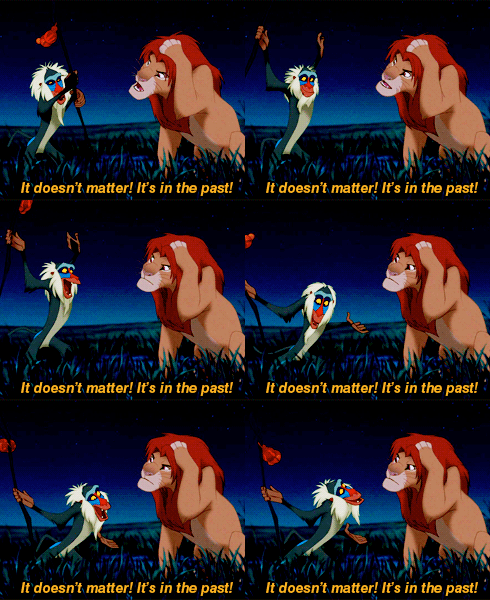
Is it really just in the past, Rafiki?

Why do I find it so hard not do dwell on the past? I know what Rafiki said “The past can hurt. But the way I see it, you can either run from it or learn from it.” But what would you do if the past keeps haunting you, as if begging you to dwell on it? Imagine someone stabbed you with a knife and your willpower (imagine them as your hands) is the only thing preventing that someone from shanking you again. That is how not dwelling on the past feels like, and every time I get shanked more than once.

Of all the things God made, this is what I question most. These emotions, these feelings. I mean, why? Why even curse us with them? Are they just crosses for us to carry through this life? Are they another means for sanctification? Are they something we must conquer? But…what if we don’t? What if we can’t? What if they finally outweigh and ultimately crush us, our spirits? What if we become tired of carrying them? What if we fail to be sanctified by them? What if they conquer us? What does one do? What do I do? I am at the last vestige of reason and patience with myself. The philosophers promised me that the mind conquers the emotions but it didn’t. Slowly but surely I am being devoured by these things that fester and feast on my soul. I know no longer what to do.